The World’s Safest Countries for Families — Ranked & Explored
The World’s Safest Countries
for Families — Ranked & Explored
Ten destinations where infrastructure works, culture welcomes children, and you spend your energy making memories instead of managing anxiety — chosen for families who travel with intention.
Here’s what nobody tells you before your first big family trip abroad: choosing where to go is only half the decision. The other half is choosing where you can exhale.
That feeling — when you’re walking a cobblestone street at dusk, your kids are ten steps ahead, and you’re not scanning for danger but simply watching them be kids in the world — that’s the feeling we’re chasing with this guide.
We spent months cross-referencing the Global Peace Index, State Department travel advisories, and conversations with parents who’ve taken their families to every one of these destinations. What we found wasn’t just about crime statistics. The safest countries for families share something harder to quantify: they feel built for human beings. The trains run. Strangers are kind. Children are seen as people worth respecting, not just tolerating.
“When kids feel safe, they don’t just see the world. They connect with it. And that connection is what you’ll talk about for the rest of their childhood.”
These ten countries made our list not just because they rank at the top of global safety indices — but because real families come home from them changed in the best way. We’ve written this for families who travel with intention — and want the honest picture of what each destination truly offers.
The 10 Destinations
Iceland
Iceland doesn’t just rank as the safest country in the world — it feels like it from the moment you land. The Global Peace Index has ranked it first for 17 consecutive years, but statistics don’t capture the ambient calm that settles over your whole family within hours of arriving.
It is also, almost inconveniently, one of the most spectacular places on Earth. Waterfalls that fall into nothing. Black sand beaches your kids will immediately want to sprint across. Geysers that erupt on a schedule. Volcanoes you can hike. Glaciers you can walk on. Iceland earns every superlative and keeps surprising you.
- Reykjavík — walkable, compact, full of culture
- The Golden Circle — the classic essential day trip
- South Coast — waterfalls and black sand beaches
- Snæfellsnes Peninsula — uncrowded and magical
- Plate tectonics & volcanic geology — live
- Geothermal energy in real-world action
- Norse mythology & Viking settlement history
- Arctic ecosystems and conservation efforts
Reykjavík rewards slow exploration. The city is compact enough that children can genuinely navigate parts of it independently — and that builds confidence fast. Within a day, you’ll notice your kids reading maps, pointing out landmarks, and leading the way. It’s subtle. It’s also powerful. Iceland commands a premium — it’s one of Europe’s more considered investments — but families who plan ahead and time their visit thoughtfully find the experience delivers at every level of travel.
Iceland practices something called útivera — a cultural commitment to being outside regardless of weather, from infancy onward. Babies nap outside in freezing temperatures. Children play unsupervised in all conditions. This isn’t neglect; it’s a deeply held belief that children who are trusted with the outdoors develop a relationship with the natural world that indoor childhoods simply cannot replicate. You’ll feel this philosophy from the moment you arrive — a kind of ambient permission for children to move freely, explore independently, and be genuinely trusted. Reykjavík is so safe and compact that families routinely let children as young as eight explore the city center independently while parents linger over coffee nearby — something most parents haven’t been able to do in any city, anywhere. Iceland also has one of the lowest insect populations of any inhabited place on Earth — for decades it was famously mosquito-free, and while a small number were documented for the first time in 2025, biting insects remain so rare here that outdoor time with young children is essentially uninterrupted. No repellent, no after-bite, no cut-short evenings. Just the landscape, almost entirely unmediated.
Ireland
If you’re taking your family abroad for the first time — or traveling with younger children who need fewer logistical variables — Ireland removes almost every barrier. English is spoken everywhere. Locals are genuinely, warmly, almost disarmingly kind to children. The landscape is so staggeringly beautiful that even teenagers will look up from their phones.
Ireland ranks consistently in the top tier of global peace rankings with one of the lowest violent crime rates in Europe. But it’s the texture of daily life that makes it feel safe — the unhurried pace, the way time slows down in small towns, the sense that people have all the time in the world for a conversation with your family.
- Dublin — history, free museums, Trinity College
- Killarney & Ring of Kerry — dramatic coastal scenery
- Galway — arts, music, bohemian energy
- The Burren — wild, lunar, unforgettable landscape
- Celtic history & ancient stone monuments
- The Famine — profound, age-appropriate history
- Irish language & oral storytelling tradition
- Literary heritage: Yeats, Joyce, Heaney
Dublin’s museum scene punches well above its size. The National Museum of Ireland is free and genuinely fascinating. Kilmainham Gaol is one of the most powerful history experiences available to families anywhere — sobering, but handled with the care that makes difficult history accessible rather than traumatic. Ireland also offers something increasingly rare in Europe: genuine warmth that extends beyond the cities. Families who venture beyond Dublin and explore the country by car discover a pace and quality of hospitality that the capital can’t quite replicate — where the landscape is extraordinary, the welcome is personal, and the sense of being somewhere real, rather than somewhere curated for visitors, is never far away.
Irish culture has a relationship with failure and embarrassment that’s unlike almost anywhere else in the world — self-deprecating humor is not a defense mechanism here, it’s a genuine social value. Children who struggle socially, who are shy, or who feel out of place in more performance-oriented cultures often find Ireland unexpectedly liberating. Nobody here is performing. The warmth is real. The conversations are real. The seanachie storytelling tradition — oral history passed through generations — is still alive in the west of the country, and children absorb it without realizing what’s happening to them. An estimated 70 million people worldwide claim Irish heritage, compared to just five million who actually live there. The Irish diaspora is one of the great human dispersals in history, and that story — of a small island that shaped an outsized portion of the world — is woven into every castle, every pub conversation, and every landscape your family will move through.
New Zealand
New Zealand occupies a rare position in family travel: it is one of the most adventure-rich destinations on the planet and one of the most peaceful. New Zealand has managed to be genuinely thrilling and extremely well-organized at the same time — a country where your kids can try new things in an environment built around their safety.
It consistently sits in the top five of the Global Peace Index. Its outdoor adventure industry is meticulously regulated — safety standards are real, not just posted on a wall. And the people are warm in a way that feels completely effortless.
- Queenstown — adventure capital for all ages
- Rotorua — geothermal wonders & Māori culture
- Auckland — diverse, modern, excellent base city
- Abel Tasman — golden beaches and sea kayaking
- Māori culture, language & living traditions
- Conservation — kiwi & endangered species work
- Geothermal & tectonic geography firsthand
- Sustainable tourism modeled at every level
Rotorua is often called touristy — fairly — but it’s one of the best places in the world to introduce children to an Indigenous culture that is genuinely alive, not preserved behind glass. Te Puia combines kiwi conservation, geysers, and cultural performances without condescension. Older kids come away with real questions about identity and what it means to protect a culture. There is one thing worth knowing before you go, however, that most travel coverage skips entirely: Rotorua smells. Strongly. The city sits on an active geothermal field and the sulfur — rotten egg, persistent, and completely unavoidable — is present from the moment you arrive. It is not a background note. For most families it becomes background noise within a day, and many children find it thrilling rather than unpleasant once they understand what’s causing it. But for anyone with a sensitivity to strong odors, or children who are easily overwhelmed by sensory experience, it is worth knowing before you book rather than discovering at the hotel entrance with luggage in hand. The experience inside Te Puia and Wai-O-Tapu is worth it — just arrive informed and prepared. The long-haul flight is often the largest line item for families traveling to New Zealand, but once on the ground, the country has invested seriously in world-class family hotels and lodges set within landscapes most travelers never reach.
New Zealand’s adventure industry operates under some of the most rigorous safety legislation in the world — operators are legally accountable for outcomes, not just disclosures. When an activity is rated appropriate for a seven-year-old, it has genuinely been tested and assessed for seven-year-olds, not simply signed off on paper. That distinction matters enormously when you’re handing your child a harness. New Zealand was also the first self-governing country in the world to grant women the right to vote, in 1893 — more than two decades before the United States. This is a nation with a long history of deciding to lead on things that matter, and that spirit shows up in how it approaches conservation, Indigenous rights, and yes, how it has built an adventure industry that families can actually trust. Older children who understand that context experience New Zealand differently — not just as a beautiful place, but as a country that has consistently chosen to be on the right side of history.
Explore all of our New Zealand coverage → New Zealand · Harper’s World
Switzerland
Switzerland rewards families who like things to work. Not in a sterile way — the country has tremendous character — but when you look at a train timetable, the train is there. When a path is marked as a family hike, someone has actually checked that a six-year-old can complete it. That reliability transforms family travel from stressful logistics into actual enjoyment.
The Alps have a particular quality of making everyone — adults and children alike — feel simultaneously tiny and capable. Kids who reach a summit, even a modest one on a family trail, often describe it as one of the best things they’ve ever done.
- Lucerne — central lake city with medieval bridges
- Zermatt — car-free village, iconic Matterhorn views
- Interlaken — adventure hub and perfect base
- Bern — relaxed, beautiful old town, easy pace
- Engineering: trains, tunnels, Alpine bridges
- Alpine ecology & climate science in real time
- Multilingualism — 4 national languages coexist
- Swiss history and direct democracy in practice
The Swiss rail network is one of the great achievements of modern civilization. For families, this means you don’t need a car if you don’t want one. Older children can be given a train card, a destination, and a meetup time — and the system is reliable enough to make this completely reasonable. Watching a twelve-year-old navigate a Swiss train connection independently, with a little anxiety and a lot of pride, is one of those travel moments that changes how they see themselves.
Swiss children as young as seven regularly navigate the national rail system independently as part of everyday school culture — not as a special experience, but as a Tuesday. The Swiss Family Card allows children under 16 to travel free when accompanied by a parent with a Swiss Travel Pass, making the network not just culturally interesting but genuinely practical for families moving between cities and mountain regions. What this creates, almost as a side effect, is one of the best environments in the world for teaching children that systems exist to serve them — that infrastructure, when done well, is a form of respect for the people who use it. Switzerland is also the only country in the world with four official national languages — German, French, Italian, and Romansh — coexisting within borders smaller than the state of Texas. Children who grow up assuming the world speaks one language encounter something genuinely corrective here: a small, prosperous, extraordinarily functional country that has made multilingualism not just possible but central to its identity.
Austria
Austria is where European culture becomes genuinely accessible — not intimidating, not requires-a-guidebook-to-appreciate, but welcoming to all ages. Vienna consistently ranks among the world’s most livable cities, and what that actually means for families is well-maintained parks, an exceptional public transit system, museums with real children’s programming, and a city that moves at a pace that suits every age in the family.
Salzburg adds the fairytale dimension — the UNESCO-listed old town genuinely looks like a film set, but it’s a working city where people live normal lives among the beauty. Children respond to Salzburg in a way that’s hard to predict and impossible to forget.
- Vienna — world-class museums, parks, culture
- Salzburg — Mozart, Sound of Music, pure beauty
- Innsbruck — the Alps and medieval history combined
- Hallstatt & Salzkammergut — Austria’s lake district
- Classical music history — Mozart, Haydn, Beethoven
- Habsburg Empire and European political history
- Art history: Klimt, Schiele, Baroque architecture
- Architecture spanning multiple centuries, side by side
Vienna’s museum scene is exceptional for families. The Natural History Museum has one of the world’s finest meteorite collections. The Kunsthistorisches Museum runs children’s tours that treat kids as capable of engaging with great art. The Prater amusement park has been operating since 1897, and the original Ferris wheel still runs. These aren’t manufactured experiences — they’re the real thing. Vienna is also one of those rare cities where its most extraordinary pleasures are woven into daily life rather than behind an entrance fee — the architecture, the parks, the Ringstrasse, the coffee houses all belong equally to everyone passing through.
Vienna’s coffee house culture — the Kaffeehaus — was formally inscribed on UNESCO’s Intangible Cultural Heritage list in 2011. Not a building. Not a monument. Not a landscape. A way of sitting together. A way of taking time. UNESCO recognized that what happens in a Viennese coffee house — the unhurried conversation, the newspaper, the hours spent over a single coffee without anyone asking you to leave — is a form of human culture worth protecting. For families, this matters in a specific way: children who experience the Kaffeehaus come home with a different relationship to stillness and conversation. Many parents report it as the unexpected highlight of a Vienna trip — not the Schönbrunn Palace, not the museums, but the Tuesday morning when nobody was in a hurry and everyone talked for two hours. Austria is also home to more than 600 castles and castle ruins — more per square kilometer than almost anywhere else in Europe — which means that on virtually any drive through the Austrian countryside, something ancient and extraordinary will appear on a hillside without being announced.
Singapore
Singapore solves a specific problem for families who want to experience Asia but feel uncertain about diving into its most complex environments. It is modern, multilingual, extraordinarily clean, and operates with infrastructure efficiency that makes navigation almost intuitive from day one. For families making their first trip to this part of the world, it functions like a brilliant orientation — Asia’s flavors, colors, and cultures presented in a context where almost everything works exactly as expected.
It is consistently ranked among the safest cities on Earth. The MRT metro system is world-class. And the food — the food is a revelation that crosses every generational boundary at a table.
- Gardens by the Bay — unmissable at any age
- Chinatown & Little India — color, culture, incredible food
- Sentosa Island — beaches and family-friendly activities
- Kampong Glam — arts quarter, heritage, great eating
- Urban planning and city design in action
- Living multiculturalism: Chinese, Malay, Indian & more
- Singapore’s remarkable independence story
- Sustainability and green urban development
Gardens by the Bay earns its hype completely. The Supertrees at night are one of those experiences that silences even the most distracted child. But Singapore also rewards eating your way through hawker centres — UNESCO-listed open-air food markets that are as much a cultural experience as a meal. Sitting at a communal table under open skies, eating dishes refined across generations by families who have done nothing else, is one of the most genuinely memorable things a family can do in Asia.
Singapore is one of the only cities in the world where a child can get genuinely lost and be safely returned — the culture of helping lost or unaccompanied children is so deeply embedded that families consistently report their children wandering off and being escorted back by strangers before parents even realize they’re gone. That’s not a small thing. It’s the kind of experience that changes how a child understands the world — that strangers can be trusted, that communities look after each other, that safety is not just the absence of danger but the presence of care. Singapore went from third-world to first-world in a single generation — one of the most intentional national transformations in modern history — and that deliberateness shows up in everything from the infrastructure to the civic culture to the way its people move through shared public spaces. For older children, Singapore raises one of the most interesting questions in contemporary life: what does a society look like when it decides, collectively, to take care of itself? The answer is all around you, and it is worth discussing out loud.
Japan
Japan does something to children that’s difficult to articulate until you’ve watched it happen. It changes their behavior — not because anyone asks them to act differently, but because the environment communicates a set of values so consistently and quietly that children simply absorb them. Waiting in an orderly queue. Saying thank you, meaning it, and having it received with genuine warmth. Japanese culture operates on a frequency of mutual respect that children pick up on faster than adults do.
Japan consistently ranks in the top twelve of the Global Peace Index. Tokyo — one of the world’s largest metro areas — has violent crime rates that would make most small American towns envious. Children as young as six ride the subway alone as a normal part of daily life. That context matters when deciding how much independence to give your own kids somewhere new.
- Tokyo — overwhelming in the very best possible way
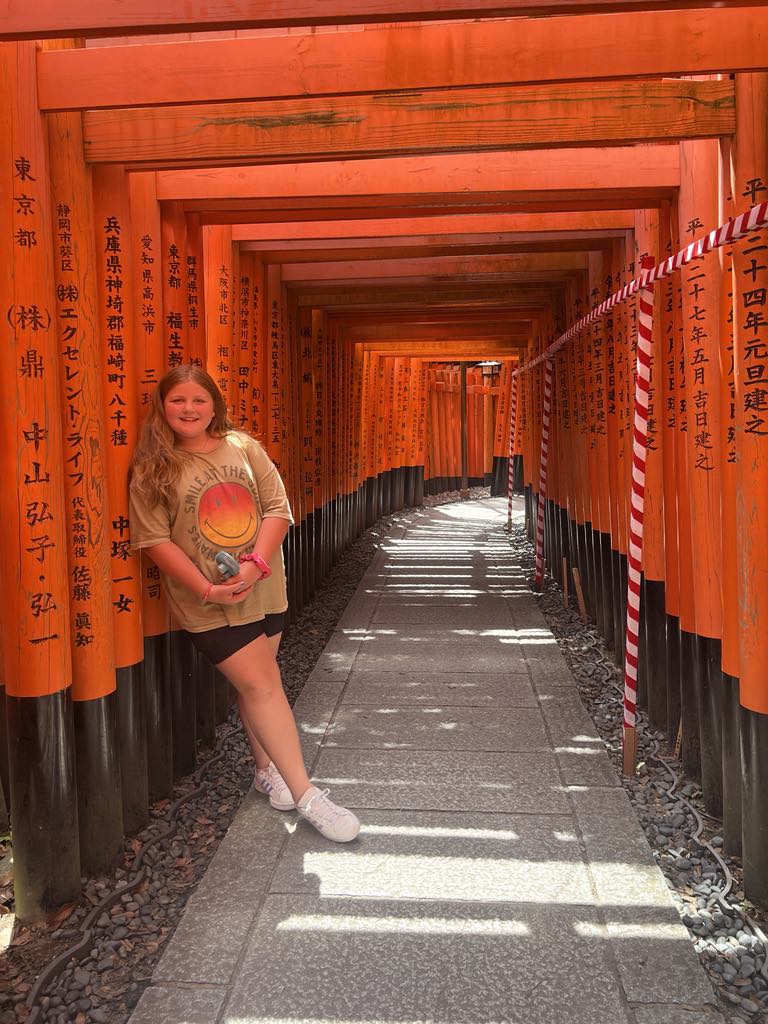
- Kyoto — temples, tradition, and incredible food
- Osaka — the people’s city, vibrant and welcoming
- Hiroshima — profound, essential, handled with care
- Respect, community & collective values in daily life
- WWII history via Hiroshima — essential for families
- Ancient tradition alongside cutting-edge technology
- Japanese language basics and writing systems
Hiroshima deserves specific mention. The Peace Memorial Museum is one of the most important historical experiences available to families anywhere on Earth — specific, human, and honest in a way that makes WWII real for children entirely differently than any classroom does. Families report their children are quiet for a long time after leaving. The conversations that follow are often among the best they’ve ever had. Japan also tends to surprise families in ways they don’t anticipate — the JR Pass transforms the country into something seamlessly navigable, and moving between Tokyo, Kyoto, and Osaka by shinkansen is itself an experience that children talk about long after they’ve returned home.
Japan has a concept called kodawari — an untranslatable word that describes an almost obsessive devotion to doing one thing with complete mastery, regardless of whether anyone is watching. You encounter it everywhere: in the chef who has spent forty years perfecting a single bowl of ramen, in the department store employee who folds your shopping bag with the precision of origami, in the street sweeper who treats a sidewalk like a personal responsibility. Children absorb kodawari without being taught it — it simply surrounds them. Many families report that their children came home from Japan applying unexpected care to things they’d previously rushed through. Japan also has a practice called oubaitori — the understanding that different flowers bloom at different times, and that comparing one to another is not only pointless but a misunderstanding of how growth works. In a culture saturated with academic pressure and comparison, encountering a society that has named and honored the opposite principle is something families carry home long after the trip ends.
Finland
Finland does childhood differently. Not louder or more elaborate — quieter, actually. There is a cultural commitment to children spending real time outdoors, in all weather, with genuine independence. Finnish children start formal school at age seven. Before that, they play. Outside. A lot. In the rain. In the snow. This philosophy permeates the experience of traveling there with your family — you find yourself slowing down, taking longer walks, sitting by a lake without an agenda.
Finland consistently ranks among the world’s safest countries and has held the title of world’s happiest country for nine consecutive years. Those aren’t unrelated facts.
- Helsinki — design, food, the sea fortress Suomenlinna
- Lapland — reindeer, huskies, aurora borealis, Santa
- Tampere — lake city, relaxed, authentic Finnish life
- Turku Archipelago — island-hopping by ferry
- One of the world’s most admired education systems
- Environmental science and Arctic ecology in person
- Sauna culture and Finnish traditions across generations
- Sustainability and responsible forest management
Lapland in winter is one of the great family travel experiences on Earth — and it’s not just Santa (though Rovaniemi is genuinely magical for young children). It’s husky sledding at dawn, the aurora making the sky move in ways that don’t seem physically possible, reindeer farms run by Sámi families, and the quality of silence in a snow-covered forest that most children have never encountered. It rearranges something in them. One practical note: Lapland in peak winter books well in advance, and rightfully so — plan early to secure the properties and experiences that make it extraordinary.
Finland has approximately 3.3 million saunas for a population of 5.5 million people — nearly as many saunas as there are registered cars in the country, and more per capita than anywhere else on Earth. That ratio tells you something essential about Finnish values: the sauna is not a luxury or a wellness trend. It is a cultural institution, a democratic space where CEOs and laborers have sat together for centuries, where business deals have been made and grief has been processed and children have been introduced to the rhythm of stillness. The finest hotels in Lapland and the Helsinki waterfront understand this implicitly — private sauna suites and lake access are not amenities here, they are the point. Finland is also the only country in the world where every child, regardless of background, receives the same quality of education — teachers are selected from the top ten percent of graduates and given the professional status of doctors and lawyers. Finnish children don’t start formal school until age seven. Before that, they play. The results speak for themselves.
Portugal
Portugal keeps getting discovered and somehow keeps being underrated. Part of this is because it sits in Spain’s shadow — louder, more aggressively marketed, more immediately recognizable to American travelers. But for families, Portugal often delivers a better version of what people are hoping Spain will be: warm weather, beautiful coastline, rich history, extraordinary food, and a pace of life that doesn’t exhaust you within three days.
It is safe — consistently ranking in the Global Peace Index top ten — with a culture of genuine warmth toward children that permeates everything from its restaurants to its streets. Portugal rewards families who travel thoughtfully, and it does so with a generosity that more famous European destinations rarely match.
- Lisbon — hills, trams, history, phenomenal food
- Porto — river city, port wine, breathtaking tile work
- Algarve — dramatic coastline, excellent family beaches
- Sintra — palaces, forests, genuine fairytale landscapes
- Age of Exploration — Magellan, Vasco da Gama, real history
- Maritime navigation and Portugal’s global impact
- Azulejo tile art — Portuguese history told in ceramics
- Portuguese language (spoken by 250 million people globally)
Lisbon works differently for families than it does for solo travelers. The hills, trams, and miradouros (viewpoints) become a game — finding the next one, counting the steps, debating which view wins. The food culture is all-ages by nature, and Atlantic beaches sit within 40 minutes of the city center. Portugal has quietly become one of the most sought-after family destinations in Europe among travelers who’ve moved beyond the obvious — drawn by a quality of experience that is deeply authentic and entirely its own.
Portugal has the warmest and most genuinely child-welcoming restaurant culture in Europe — and that is not a casual observation. Children are not tolerated in Portuguese restaurants; they are celebrated. Families who have experienced the polite indifference of London dining rooms or felt the quiet disapproval of a Parisian waiter are often genuinely moved by how differently their children are received in Lisbon and Porto. A child wandering toward the kitchen is guided back with a smile and a pastry. A toddler’s noise is met with warmth rather than thinly veiled irritation. Dining out in Portugal is one of the great underrated family experiences in the world — and it happens at every level, from a neighborhood tasca to a white-tablecloth restaurant overlooking the Douro. The azulejo tile panels at São Bento station in Porto — 20,000 tiles depicting Portuguese history, installed by artist Jorge Colaço over eleven years — are one of the most unexpectedly immersive history experiences available to families in Europe, and you encounter them while waiting for a train. Portugal also gave the world the word saudade — an untranslatable longing for something beautiful that has passed or may never come. Once you know it exists, you hear it in the fado music drifting from restaurant doorways, and feel it in the late evening light over the Tagus. It is the kind of word that, once learned, a child carries forever.
Slovenia
Slovenia is the answer to a question many families are asking right now: where in Europe can we go that feels like the places we’ve heard about — the Alps, old-town charm, stunning scenery — without the crowds that have made those places so difficult? The answer, consistently, is Slovenia.
It is extraordinarily beautiful. Lake Bled looks like a postcard even when you’re standing in it — a medieval island church in an Alpine lake with a castle on the cliff above. On a Tuesday morning in early June, you can rent a rowboat, row to the island, ring the bell in the church tower, and have the entire experience feel almost private. That version of Europe still exists here.
- Lake Bled — iconic and every bit worth it
- Ljubljana — charming capital, completely walkable
- Triglav National Park — hiking, rivers, pure nature
- Soča Valley — impossibly blue-green river, WWI history
- Alpine ecology and karst geology formations
- WWI Soča Front — history embedded in the landscape
- Conservation and national park stewardship
- Multilingualism in a small, independent nation
Ljubljana — the capital — is one of the most underrated cities in Europe for families. Small enough to navigate in a day or two, large enough for excellent restaurants, museums, and culture. The old town is car-free. The castle above the city is accessible by funicular. And because Slovenia is still off most family travel radar, locals haven’t developed the tourist fatigue that makes some famous European cities feel unwelcoming. It also happens to offer the natural drama of Switzerland or Austria at a fraction of the investment — a distinction that’s not lost on families who’ve done both.
Slovenia was the first country in the world to declare its entire territory a green destination — a national commitment to sustainability that shapes everything from how its national parks are managed to how its capital city handles waste and urban planning. This isn’t marketing language; it’s policy, embedded in the way the country operates. Ljubljana was named European Green Capital in 2016, and its car-free old town, riverside café culture, and urban forest cover make it one of the most genuinely livable small capitals in Europe. The Soča River — running through the country’s western valley in a shade of blue-green that seems digitally enhanced even when you’re standing in it — flows through terrain that witnessed some of the most brutal fighting of the First World War. The Isonzo Front, as it was known, claimed over 300,000 lives across eleven battles fought in this same extraordinary landscape. Walking the Soča Trail with older children means moving through beauty and history simultaneously — understanding that the most peaceful places often carry the weight of what came before them, and that the work of keeping them peaceful is never finished.
Why Safety Changes Everything
Choosing a safe destination isn’t playing it small. It isn’t timid. It is, in fact, one of the more sophisticated decisions a traveling family can make — because it determines what kind of trip you actually have.
When you feel safe, you say yes more. You let the day unfold instead of managing it. You let your kids lead down a side street without the low-grade anxiety that comes from not fully trusting the environment. The best family travel memories — the ones that come up at dinner tables ten years later — almost always happen in those unplanned, unhurried moments. And those moments require safety to exist.
“The countries on this list aren’t just safe by the numbers. They’re places where the culture itself communicates something worth teaching — that public space is shared, that strangers deserve courtesy, and that children are worth investing in.”
The world doesn’t run short of beautiful destinations. What it runs short of is the kind of travel that leaves a family genuinely changed — where children come home more curious, more capable, and more at ease in the world than when they left. These ten countries offer that. Not because they are perfect, but because they are safe enough, rich enough, and human enough to let the real experience in.
Explore more family travel inspiration on the Harper’s World YouTube Channel, where destinations come to life through video